Selling?
Here are Some Tips
If you are selling your home, do it with excellence, honesty, and local expertise. I will help you build an optimized gameplan and marketing strategy around your timeline and needs.

Where Do You Start?
Where do you start with anything? Hopefully, the answer that popped into your mind was, “asking questions”.
Here are the preliminary questions you should ask yourself:
How quickly do I need to sell and find a new place to live?
How much effort and resources do I want to spend making my home “show” competitively?
What are homes similar to mine selling for, in my area?
How long are homes like mine taking to sell, in my area?
Are there any odd, broken, or inconvenient things about my house and property, that I would want to know about if I was buying it today?
Asking these questions will help us understand what strategies to use when building your selling gameplan and help set reasonable expectations.
-
How do you know how much your home is worth?
One way is to go on various real estate websites and use their estimator tools. However, these estimates usually overlook the niche details of local market dynamics and miss the most relevant data for your home.
The best way to understand your home’s value is to either:
1) Order an appraisal report from a licensed appraiser. While not always perfect, these reports typically build the most robust case for your home’s value. The downside is that they cost money and they become obsolete as market conditions change, especially during uncertain economic environments.
2) Have a real estate agent conduct a free comparative market analysis for you (aka CMA). These are similar to an appraisal, but are not formal reports and not as robust. Lenders do not use them to determine value, but they are still helpful in understanding where your home stands in the current market. They beat out online tools, because they are more attentive to local nuances and the latest data.
-
In real estate, sellers have a legal obligation to disclose what they know about their property (i.e. the material facts that affect value).
However, sellers are often unaware, forget, or do not know how to look for these facts. Because of this, there is a high probability that buyers will find something that was not initially disclosed and be granted a legal reason for exiting a purchase contract.
By disclosing up front, sellers can reduce their chance of having a buyer walk away from a contract. This will likely reduce the time your home is on the market, leading to a quicker sale. It will also increase your odds of receiving your asking price.
Thus, while inspections do have a cost, they can potentially save you much more, in the grand scheme.
Let’s put this into an example:
Bob decides he wants to buy a home and finds one he likes. Him and his agent write an offer to purchase the home. The seller accepts and Bob has 10 days to investigate the property. He orders a home and pest inspection. Upon completion, he finds out that their is a termite infestation in the crawl space, beneath the home. Because this was not disclosed prior to entering the contract to buy, Bob can legally back away from the agreement or choose to renegotiate the deal. In this case, he decides he can find another home.
Jerry, the seller, is upset. He decides to hire professionals to eliminate the infestation, limiting access to the property and loosing them a weekend of open houses. Homes in Jerry’s neighborhood are being sold, in the meantime, while his sits on the market.
The infestation is finally dealt with and now Jerry has more documentation to disclose to new buyers. Eventually, a new offer comes in, but it is $80,000 less than what he was asking. The home has been on the market for 73 days now and no other offers have come in. Jerry accepts, but feels frustrated with how the whole process went. He also learns that a similar home, down the block, with a recently fixed termite infestation, sold for $50,000 more than his and Bob was the buyer. The only difference was that the other sellers disclosed the fixed infestation up front, before accepting an offer.
-
You can set yourself up for success by:
#1) Ordering inspections before we go live on the market. This will enable us to improve marketability and reduce the likelihood of falling out of contract.
#2) Declutter, declutter and declutter. Clear as much surface space as possible, take down family pictures, hide valuables, conceal passwords, and remove anything that could be taken offensively by other people.
#3) Allowing time and space for professional cleaning and photography, which will significantly improve your home’s showing prowess.
#4) If you plan on living at the house while it is on the market, keep your footprint small and the home clean. We will have buyers that want to see the property outside of open house hours.
#5) Plan time to be away from the house, on the weekends, so that we can host open houses.
#6) Pack as many things as possible and have your moving company chosen.
#7) Have an accountant, attorney, and any other legal advising you need ready, for navigating tax efficiency and other legal matters (especially if dealing with family trusts).
#8) If you have questions, or concerns, never hesitate to ask. Clarity leads to confidence and confidence nurtures calmness. My hope is for you to feel the least amount of stress and understand more than when you began the process.
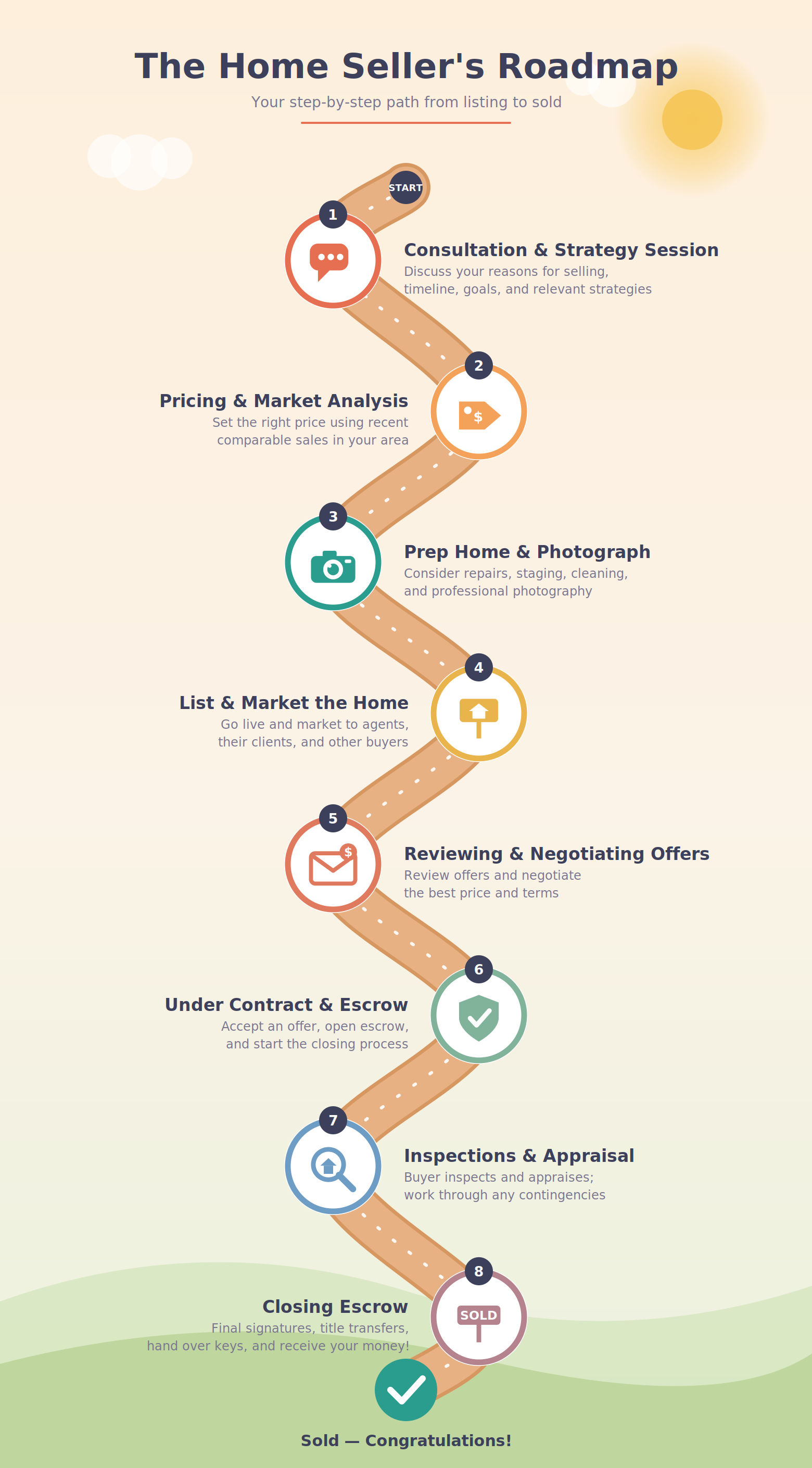
40,000ft View
Every sale has a unique story. Seasonality, macro economic conditions, and the differences between buyers all affect how a sale plays out. A smooth sale has need for strategic foresight, diligent data analysis, captivating marketing, capable negotiating tactics, knowledge about the consequences of contractual obligations, and local insight; amongst other elements. This roadmap, on the right, provides a flow for how a sale should go. However, a mindset of adaptability and endurance is needed for the detours and recalibration that will likely arise throughout the process.
How Long Does Selling a Home Take?
As with buying a home, there is no quick and clear answer to this, as every seller has a different set of circumstances. However, to give you a rough idea, I’ll break down a scenario below, following the flow of the roadmap graphic:
Day 1: “Consultation & Strategy Session” → 30min-1hr meeting, where we build a plan and outline strategies, tailored to you and current market conditions. If you decide to work with me, we will also sign a listing agreement and discuss a price to list your home for.
Day 2-15: “Prep Home & Photograph” → 1-2 weeks. During this period we will prepare the disclosure package that we will be distributing to buyers. This package will include your knowledge about the property and professional inspections, which will mitigate the risk of any accidental concealment of facts, pertaining to the value of your property. The goal here is to reduce as many deal-killing factors as possible, before entering into a purchase agreement with a buyer.
We will also clean the home and prepare it for professional photography, in order that your home stands out in our marketing content.
As a side note, we might have discussed repairs, or renovations that you want to complete before listing. This would elongate this stage of the process, varying upon the availability of contractors, materials, weather, etc. In Santa Cruz County, specifically, the demand for quality contractors and professional inspectors can add an extra few weeks, to multiple months of time.
Day 16 → Entering into Contract: “Reviewing & Negotiating Offers” → 0-3+ months. This is the most variable phase of the process, because it depends upon the market conditions, time of year, weather, and the competitiveness of other homes for sale, similar to yours. However, it is almost always a matter of ‘when’ and ‘at what price’ your home will sell; not a questions of ‘if’.
In a balanced market, homes usually sell between 15-45 days on market, with outliers of course. However, in a market favoring buyers, they can sit for many months and sell at large discounts (offers are submitted under the list price). Inversely, in a market favoring sellers, they can be on for only few days and sell at large premiums (offers are submitted over the list price).
Entering into contract → Closing: “Under Contract & Escrow” → ~30-45 days. Once we have negotiated and accepted an offer, the transaction usually takes ~30-45 days to close. It is during this phase when the buyer will conduct their due diligence, order inspections (if any) and wait on an appraisal report, if they are financed. Depending on the contract’s contingency clauses, certain discoveries of material facts can enable buyers to pull out of the contract, or renegotiate terms. This is why it is essential to disclose as many facts as possible before entering into a purchase agreement.
In conclusion, from Day 1 it can take anywhere from 1-3+ months to find a buyer and close the sale. As a general rule, the most common timeline to enter contract and close is between 30-60 days. If it is taking much longer, your home could have a narrower pool of buyers, the market could be unfavorable towards you, or other external factors could be chasing away demand.
If you want to understand the current, local market conditions and how long homes like yours are taking to sell, call me at (831)-212-0947
Sincerely,
Landon H.